

Enhancing Geospatial and Data Collection Capacity: SWALIM Delivered Drone and UAS Licensing Training to IMC PL, IMC SL, SNBS and SWALIM GIS staff
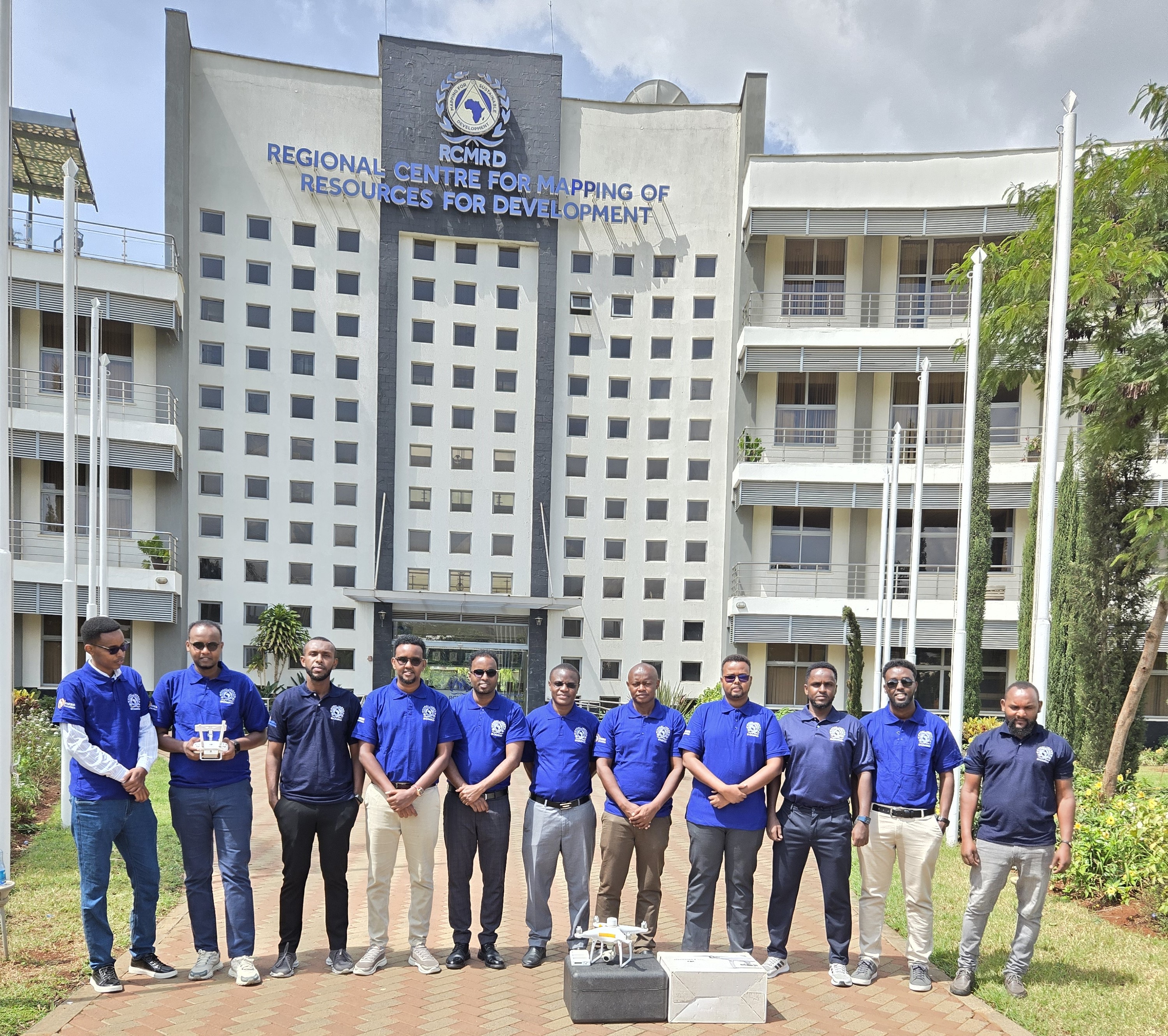
Drone technology has become an important component of the geospatial sector for managing land and water resources, including flood-affected areas, canal infrastructure rehabilitation, and monitoring of urban expansion. Through UAV operations, data acquisition, and geospatial applications, drones enable the collection of high-resolution data in areas that are difficult or impossible to access through conventional methods. To build national capacity and introduce the latest drone technologies, national staff from IMC Somaliland, IMC Puntland, the Somali National Bureau of Statistics (SNBS), together with FAO SWALIM GIS staff, participated in a two-week professional licensing drone and Unmanned Aerial Systems (UAS) training held in Nairobi and delivered by Fahari Aviation in collaboration with the Regional Centre for Mapping of Resources for Development (RCMRD).
FAO SWALIM, participation in this training directly supports its mandate to strengthen national systems for land, water, agriculture, and climate impacts across Somalia. The skills gained in UAV data collection and geospatial analysis enhance the ability to generate timely, high-resolution spatial information to support drought-flood risk assessment, land and water resource management, and evidence-based planning and interventions. Therefore, integrating drone-derived products into existing geospatial workflows, SWALIM continues to reinforce its role in supporting government institutions with reliable data for decision-making.
The training began with core theoretical modules covering UAV fundamentals and operational safety. Participants were introduced to UAS types, aviation safety principles, air legislation, and regulatory frameworks governing drone operations. Key topics included human factors, meteorology, navigation, and flight planning, with emphasis placed on understanding airspace, weather conditions, and risk assessment to ensure safe and compliant UAV missions.
Building on the theoretical foundation, the second module focused on practical flight operations and mission execution. Participants learned principles of flight for multi-rotor systems, aircraft technical components, radio telephony, and operational procedures. The sessions covered real-world applications, including site assessment, hazard identification, checklist use, and decision-making processes required for effective and safe drone deployment.
The second part of the training focused on hands-on practical sessions, during which participants conducted supervised flight operations and applied data acquisition techniques. Additional emphasis was placed on translating UAV data into usable geospatial outputs such as extraction of Digital Elevation Model (DEM), Digital Surface Model (DSM) and Digital Terrain Model (DTM).
Following the practical flight training, participants underwent formal examinations administered under the Kenya Civil Aviation Authority (KCAA) framework for the Unmanned Aircraft Systems (UAS) Remote Pilot Licence (RPL). The final assessment was an important milestone in the training programme, because of ensuring that participants met the required competency and regulatory standards for professional drone operations.
The training concluded with a closing session attended by representatives from the organising institutions, who commended the participants for their commitment and active engagement throughout the programme. Participants were encouraged to apply the skills acquired in their respective institutions to support operational mapping, planning, and decision-making. Certificates of participation were awarded to all trainees, and appreciation was expressed to Fahari Aviation and RCMRD for delivering the training.
English
Thumbnail Image:
Feature Article:
Yes
- Log in to post comments