






Swalim News and Events
Somalia Ground Water Monitoring Webinar
FAO SWALIM in collaboration with the Federal Government of Somalia’s Ministry of Energy and Water Resources will be hosting a webinar to discuss the ongoing Groundwater monitoring in Somalia. This critical information will be instrumental in planning for the forecast LaNina and related humanitarian interventions.FAO-SWALIM Work in Puntland
Since 2006 Somalia Water and Land Information Management (SWALIM) has been operating in Puntland. Informative data has been collected on land, water and climate. The information is organized in themes: Water resources (Climate, floods, water resources and water reports); Land resources (Land degradation, Land suitability, soils and land reports). This information is generated with the support of a strong Information management, GIS and remote sensing units in collaboration with Puntland government partner institutions. SWALIM information management team has organized the data to facilitate quick retrieval through a variety of online and offline platforms. Download publication (pdf, 3.5 MB)
The Puntland water and land resources – Information Management Center
The Information Management Center (IMC) will be a special agency under the Puntland State of Somalia whose main function shall be to collect, process and analyze water and land resources information in coordination with the relevant government institutions, in support of policy development for sustainable and integrated water and land resources management, and to provide water and land related data and information to the end users. Download pdf(2.5 MB)
Journal Publications
Regional-Scale Planning of Water Harvesting Interventions in Somali Arid Areas - A Multicriteria ApproachIn focus
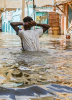
Strong El Niño weather condition raises risk of severe Deyr flooding in Somalia, FAO warns
01/09/2026 A strengthening El Niño weather condition and an exceptionally strong wet-season forecast are raising the risk of significant flooding across Somalia during the October–December (Deyr) 2026 season, the Food and Agriculture Organization of the United Nations (FAO) has warned.
Intensifying Somalia drought likely to be as severe as previous prolonged dry periods, FAO warns
New data compiled by the Food and Agriculture Organization (FAO) shows that the 2025-26 drought is intensifying rapidly and is likely to be as severe and widespread as previous major droughts of 2022, 2017 and 2011. The analysis is based on data compiled by FAO’s Somali Water and Land Information Management System (SWALIM) system, who have recently updated their Combined Drought Index (CDI).
SWALIM conducted an early warning (diginin) systems training to ministry of Agriculture development in Somaliland
Across climate-vulnerable regions, timely data alone is not enough to prevent crises. The real challenge lies in ensuring that early warning information is clearly understood, trusted, and used to guide decisions. Many professionals receive climate and hazard data but lack the confidence or skills to translate it into action.
From Early Warning to Early Action: Empowering National and State Institutions to Strengthen Flood Resilience in Somalia
Across Somalia, recurrent flooding continues to undermine food security, displace families, and erode development gains, particularly in riverine and low-lying areas. While floods are a recurring hazard, their impacts are increasingly predictable. Building resilience therefore depends not only on forecasting floods, but on strengthening national systems that enable early, anticipatory action to protect lives, livelihoods, and essential services before damage occurs.SWALIM Publications
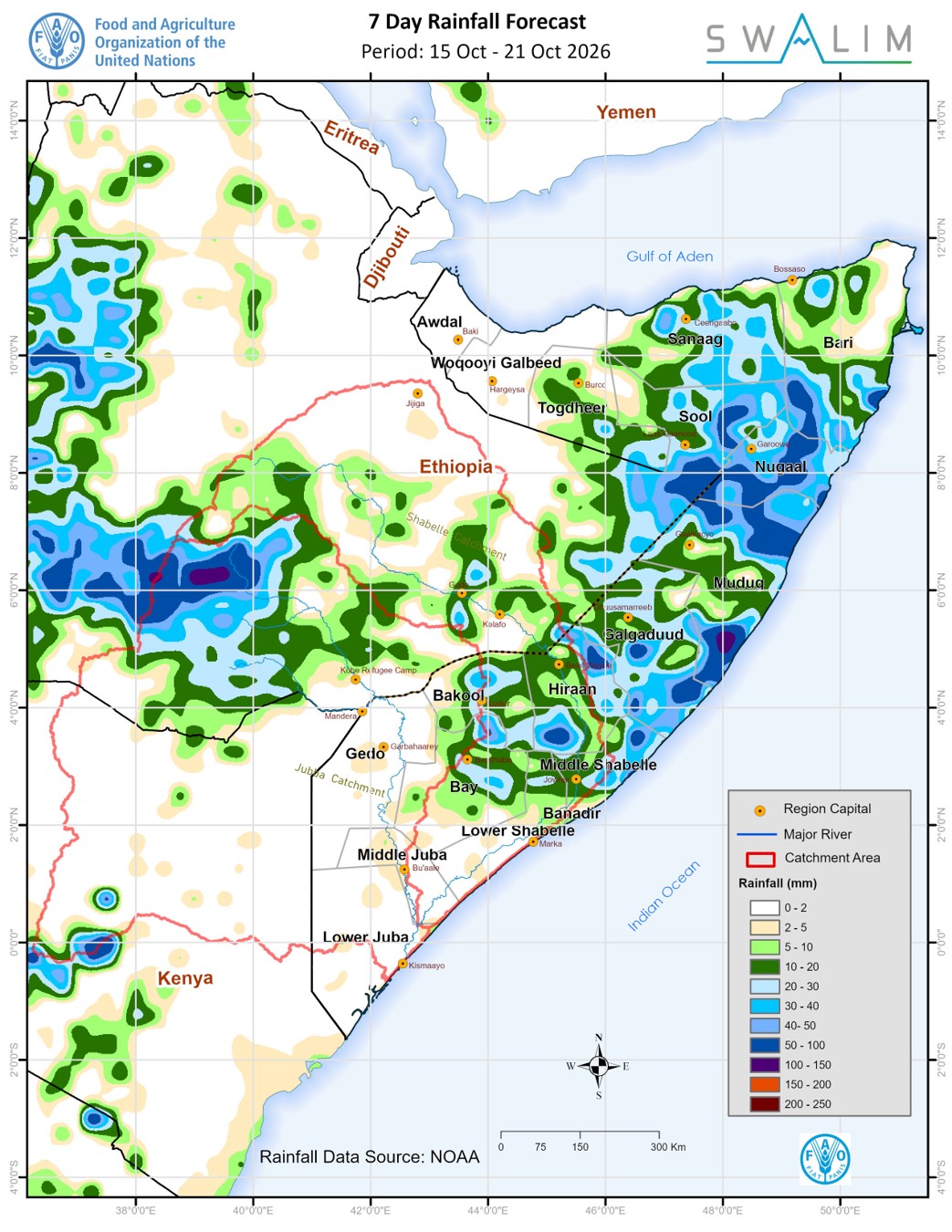
Somalia Rainfall Forecast – Issued 15 October 2026
According to NOAA-NCEP GFS model forecasts, moderate rains this week are expected over central and north-eastern Somalia, particularly Mudug, Nugaal, Sool and Galgaduud.Publication Download
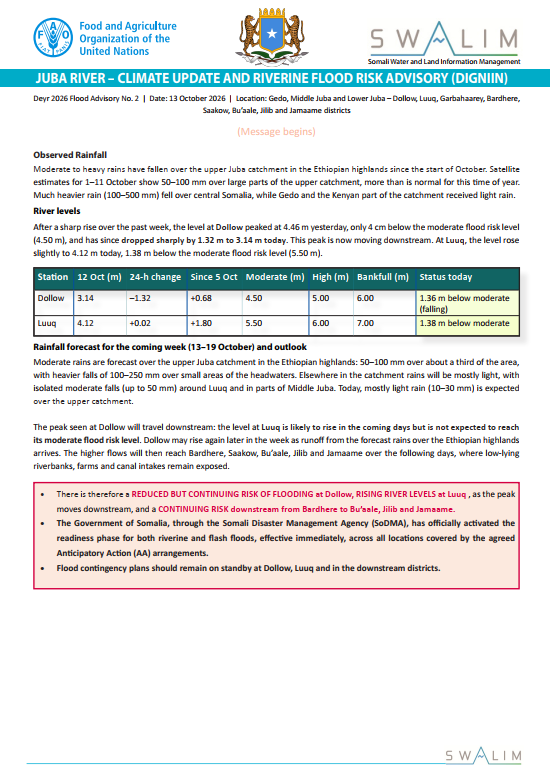
Juba and Shabelle River Advisory on Flood Risk - Issued 13 Oct 2026
FAO SWALIM has issued the latest Juba and Shabelle River Flood Risk Advisories, dated 13 October 2026, highlighting current river conditions, rainfall forecasts for 13–19 October, and potential flood risks across affected areas of Somalia.Publication Download
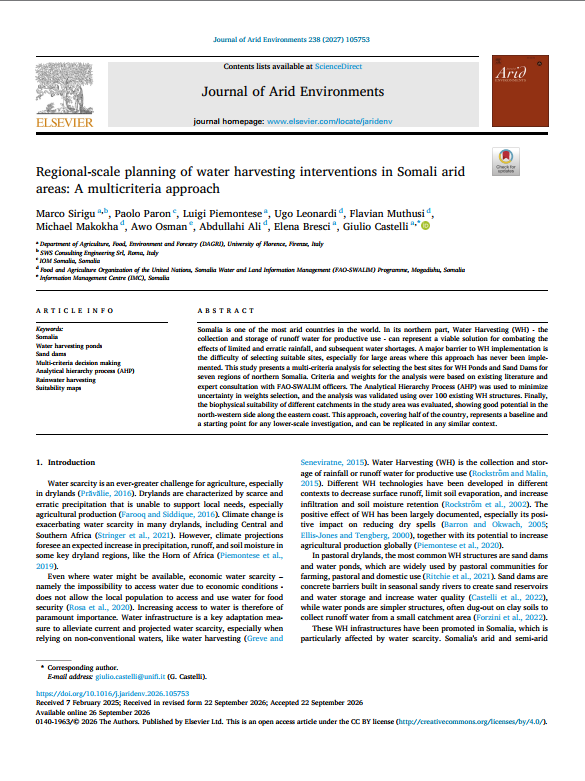
Regional-Scale Planning of Water Harvesting Interventions in Somali Arid Areas - A Multicriteria Approach
Somalia is one of the most arid countries in the world. In its northern part, Water Harvesting (WH) - the collection and storage of runoff water for productive use - can represent a viable solution for combating the effects of limited and erratic rainfall, and subsequent water shortages.Publication Download
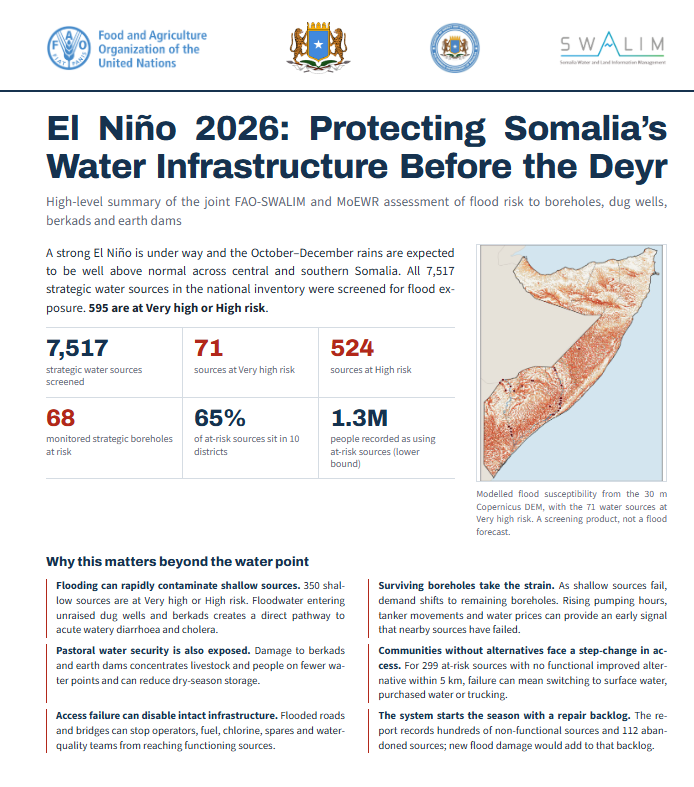
Anticipated El Nino Impacts on Water Resources and Water Infrastructure
The joint FAO-SWALIM and MoEWR assessment of anticipated El Niño impacts on Somalia’s water infrastructure. Of 7,517 strategic water sources screened, 595 are at Very high or High flood risk, and they serve at least 1.3 million people.Publication Download
Donors
SWALIM is a multi-donor project managed by FAO and currently funded by The European Union, The World Bank, FCDO, AICS, SDC, Canada, Sweden and GCF



 ;
;